Why Fall Might Be the Best Time to Evaluate Blue Ridge Real Estate


There’s an obvious reason people love Blue Ridge in the fall. The weather cools off, the leaves change, downtown gets busy, and for a few weeks the mountains put on a pretty spectacular show. If you’re thinking about buying a home here, I like fall for a completely different reason.
The mountains start telling you the truth.
A property that looks fantastic on a sunny July afternoon can reveal an entirely different side of itself once the leaves begin falling, the weather gets wetter, temperatures drop, and Lake Blue Ridge starts moving toward its lower seasonal level. For someone evaluating Blue Ridge real estate, that can be incredibly useful because you begin seeing things that are simply harder to spot during summer.
Views change. Privacy changes. Roads and driveways can behave differently. Drainage becomes easier to understand. Heating systems suddenly matter. And if you’re looking at Lake Blue Ridge property, the relationship between the house, the dock, the shoreline, and the water itself becomes a lot more obvious.
That’s why I don’t necessarily think of fall as simply a “good time to buy.”
I think it may be one of the best times to figure out exactly what you’re buying.
Why Blue Ridge Real Estate Can Be Easier to Evaluate in Fall
Mountain views can be tricky. You’ll see terms like “year-round mountain view,” “seasonal view,” “long-range view,” and even “potential view” in listings, and those phrases can mean very different things.
A house surrounded by hardwoods may have a beautiful fall and winter view that almost completely disappears once the leaves return. On the other hand, a listing may make a big deal about the view, but once you’re actually standing on the deck, you realize you’re really looking through a fairly narrow opening between trees.
That matters because buyers often pay a premium for views in the Blue Ridge market. If part of the value of the house is the view, I want to understand exactly what that view looks like throughout the year, not just what it looked like on the day the listing photographer happened to be there.
Fall also starts revealing things that heavy summer foliage can hide surprisingly well... like neighbors.
A house may feel completely secluded in July, then November comes along and suddenly another cabin, driveway, or road is visible through the trees. That doesn’t necessarily make the property less desirable. You may barely notice the neighbor. But if privacy is one of the main reasons you’re moving to the mountains, I’d rather know what “private” really means before you own the place.
Mountain Roads and Driveways Start Telling You More
This is one of those things that’s hard to fully appreciate until you’ve spent some time looking at mountain property. The house can be wonderful but getting to it can be another story.
Some Blue Ridge homes are reached by wide paved roads with easy grades. Others involve gravel roads, switchbacks, narrow private roads, steep driveways, or some combination of all four. During a long stretch of dry summer weather, almost anything can look manageable.
Fall can tell you considerably more. After a good rain, you may see where water crosses the driveway, where gravel is washing, whether ditches and culverts are doing their job, and whether that steep paved driveway becomes a whole different animal when it’s covered with wet leaves.
None of that automatically makes a property bad. Sometimes a slightly more difficult road is part of what gives you the privacy and view you wanted in the first place, it just gives you more information. If I’m helping someone evaluate a mountain home, information is exactly what I want.
A buyer moving here from Atlanta or Florida may naturally spend more time looking at the kitchen than the driveway. I’m probably looking pretty hard at both.
Rain Can Actually Be Your Friend
Nobody plans a weekend trip to Blue Ridge hoping for three straight days of rain but from a real estate standpoint, I don’t necessarily hate it. We build houses into the sides of mountains around here. Water has to go somewhere, and a wet fall day can give you a pretty good idea of where that somewhere is.
Are the gutters doing their job? Are the downspouts carrying water away from the foundation? Is water moving toward the house or away from it? Is there erosion along the driveway? How are retaining walls handling runoff? Does the crawlspace feel damp? Are there obvious drainage channels running across the property?
Mountain homes often need drainage systems that would look completely unnecessary on a flat suburban lot. That doesn’t mean there’s a problem. It just means the property has to manage water properly.
I’d much rather see that system working before closing than find out afterward that it doesn’t.
Cooler Weather Lets the House Show You Something Too
A July showing tells you a lot about the air conditioning. Fall starts introducing you to the other half of the house.
Does the heat pump work properly? How evenly does the house heat? Does that big stone fireplace actually function? Is there propane? Radiant heat? Mini-splits? A generator?
Some of the larger homes around Blue Ridge and Lake Blue Ridge have soaring ceilings, huge walls of glass, and enormous open living spaces. Architecturally, they can be spectacular, but architecture and efficiency aren’t always the same thing.
I’m not necessarily looking for the house with the lowest utility bill in Fannin County. I just want my buyer to understand the house they’re buying.
That’s a lot easier to do when the temperature outside isn’t 85 degrees.
Lake Blue Ridge Gets Especially Interesting in Fall
If we’re looking at Lake Blue Ridge property, fall becomes even more useful.
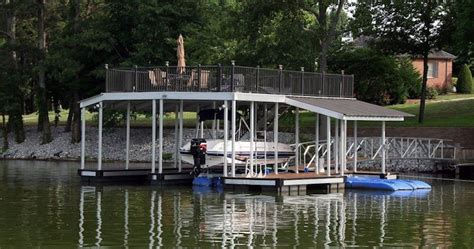
Lake Blue Ridge is a TVA reservoir, so the water level changes seasonally. That means the beautiful July photograph showing a boat tied to a dock with water right underneath it doesn’t necessarily tell you everything you need to know.
As the lake moves away from summer pool, you start seeing the waterfront differently. How does the shoreline change? How does the dock sit as the water falls? How steep is the walk from the house to the dock? How much shoreline becomes exposed? And if maintaining usable water around the dock for as much of the year as possible is important to you, what happens as the lake continues to drop?
Those are not small questions if the reason you’re paying a premium for the property is because it’s on Lake Blue Ridge.
Not every lakefront property behaves the same way during seasonal drawdown. Where the house sits on the lake, the shoreline configuration, the surrounding terrain, and the depth of the water around the dock can all matter. That’s one of the reasons I’ve been spending so much time studying Lake Blue Ridge itself instead of simply studying lakefront listings.
A beautiful summer photograph can show you why you want the house.
Fall may start showing you what you actually own.
Fall Makes Mountain Land Easier to Understand
One of the easiest things to underestimate in mountain real estate is the land itself. Five acres can mean almost anything around Blue Ridge.
It could be five gently rolling acres with plenty of usable ground. It could also be five acres where approximately four and a half of them appear to be trying to fall off the mountain.
Once the leaves begin coming down, the terrain becomes considerably easier to read. Contours are more obvious. Creeks and drainage areas can be easier to see. Old roads or trails may suddenly appear. You may get a much better sense of how much of the land is actually usable.
This can be especially helpful in places like Morganton and Cherry Log, where buyers may be looking for more acreage, more privacy, or simply a little more distance from downtown Blue Ridge.
The number of acres printed in the listing only tells you so much. How those acres actually lay can tell you a lot more.
Fall Also Lets You See Blue Ridge at Full Speed
October in Blue Ridge isn’t exactly quiet.
That’s actually useful information if you’re thinking about living here.
Downtown can be packed. Restaurants get busy. Traffic increases. Vacation rentals are occupied. There’s a lot going on.
Some people absolutely love that. They want to be close enough to downtown Blue Ridge to enjoy the restaurants, shops, festivals, and activity whenever they feel like it.
Other buyers spend one busy fall weekend here and realize they want ten or fifteen minutes between themselves and all of that. That’s where areas around Lake Blue Ridge, Morganton, Cherry Log, and quieter parts of Fannin County can become especially appealing.
Neither choice is right or wrong. It’s a lifestyle decision.
And although my focus is Blue Ridge, the same thing applies if you’re comparing it with another mountain market such as Ellijay. These towns can feel very different depending on the time of year and exactly where you live in relation to the busiest areas.
If you’re thinking about making a major move, experiencing the area at one of its busiest times is useful information too.
Is Fall Really a Better Time to Negotiate?
Maybe.... but I wouldn’t assume it.
There’s a popular real estate storyline that once summer ends, sellers suddenly become desperate and buyers can start throwing low offers around. It doesn’t work that neatly.
A great Blue Ridge property that’s priced correctly can attract serious buyers in October, November, or February. An overpriced property may sit regardless of the season.
What interests me far more is what’s happening with that specific house. How long has it been listed? Has the price already been reduced? What have comparable homes actually sold for? How much competing inventory is available? Has the house already been through a strong selling season without receiving an acceptable offer? Do we have any reason to believe the seller is particularly motivated?
Those things can create negotiating leverage. The fact that there are leaves on the ground doesn’t.
I’d rather look at the actual property, the actual market, and the actual numbers than assume the calendar is automatically giving us an advantage.
Fall Gives You a Preview of Winter
Blue Ridge isn’t Minnesota, but we absolutely get freezing temperatures.
And mountain terrain adds another dimension to winter weather. Elevation matters. Shade matters. Steep driveways matter. A road with northern exposure can behave very differently from one that gets direct sunlight most of the day.
Exterior plumbing matters. Well houses matter. Generators can matter.
If you’re buying a second home that may sit vacant for extended periods, winter preparation matters even more.
None of those things are reasons not to buy a mountain home, they’re simply part of understanding mountain home ownership.
You’re Buying More Than the House
When you buy Blue Ridge real estate, you aren’t just buying bedrooms, bathrooms, and square footage.
You’re buying the driveway.
You’re buying the hillside.
You’re buying the trees.
You’re buying the view.
You’re buying the drainage.
You may be buying a private road, a well, a septic system, or several acres of mountain land.
If you’re buying on Lake Blue Ridge, you’re buying that property’s relationship with the lake too.
Fall has a way of making some of those things easier to see.
That’s valuable, because I’m not trying to sell you a house. I’m simply trying to help you make a great decision.
Sometimes that means finding reasons to buy the property. Sometimes it means finding a reason to walk away.
Both can be successful outcomes.
Ready to make your move? If you’re considering buying or selling in Blue Ridge, Lake Blue Ridge, or the surrounding mountains and you’re looking for relentless representation, reach out , I’d love the opportunity to help.


Comments