What Does a Seasonal Mountain View Really Mean in Blue Ridge?


If you spend much time looking at real estate around Blue Ridge, you’re eventually going to see a listing that advertises a “seasonal mountain view. That sounds pretty straightforward. It usually means you get a better view when the leaves are off the trees. But that description can cover a surprisingly wide range of properties.
A seasonal mountain view could mean a genuinely impressive long-range view from November through early spring that becomes partially screened during summer. It could mean a decent mountain view through the trees for several months of the year. Or, if we’re being less charitable, it could mean there’s technically a mountain out there somewhere if you stand in exactly the right spot on the deck and look between two oak trees.
That’s why I think buyers need to look past the phrase itself and figure out exactly what kind of view they’re actually buying.
What Is a Seasonal Mountain View?
A seasonal mountain view generally means the view changes significantly depending on whether the surrounding trees have leaves. Around Blue Ridge, Cherry Log, Morganton and much of Fannin County, hardwood forests are a big part of the landscape. In summer, mature oaks, maples and other deciduous trees can create an almost solid wall of green. Once those leaves fall, an entirely different landscape can appear behind them.
Sometimes that difference is dramatic.
I’ve seen properties where summer photographs suggest there isn’t much of a view at all, but once the leaves are down, multiple mountain ridges suddenly become visible. In other cases, what looks like a substantial view in a winter listing photograph becomes almost completely hidden by May.
Neither situation automatically makes the property good or bad.
The important thing is understanding which one you’re buying.
A Seasonal Mountain View Can Still Be a Great View
I don’t think buyers should automatically treat the word “seasonal” as a negative.
In fact, there are properties around Blue Ridge where I’d happily take the seasonal view.
A heavily wooded lot can give you privacy and shade during summer, then open up to a beautiful mountain view throughout late fall and winter. If you’re primarily using the house during cooler months, that might actually work extremely well.
There’s also something to be said for having both experiences.
In summer, you feel tucked into the woods. In winter, the mountains open up.
That can be a pretty good combination.
The problem comes when the buyer believes they’re purchasing a significant mountain view and later discovers that the view they fell in love with during a February showing practically disappears six months later.
That’s a very different situation.
Seasonal Mountain View vs. Year-Round Mountain View
A true year-round mountain view generally means that a substantial view remains even when the surrounding hardwoods are fully leafed out. Those properties can carry a premium, particularly when the view is long-range, layered, or especially dramatic.
But even “year-round” deserves a little investigation. How wide is the view?
Can you see it from the main living area or only from one corner of the deck?
Does the view depend on maintaining vegetation on the property?
Are you looking across your own land or someone else’s?
Those details matter because mountain views aren’t just about what you can see today.
They’re also about what could change tomorrow.
The Trees Creating the Problem May Not Be Yours
This is something buyers don’t always think about. Suppose you’re standing on the deck of a Blue Ridge cabin and there’s a beautiful mountain ridge visible through several trees. Your first thought may be, “We could probably trim a few of those and open this view up.”
Maybe... but whose trees are they?
If the trees are on your own property, you may have some options, subject to any community restrictions, covenants or other limitations. If the trees are on the neighbor’s property, that is a completely different conversation.
You generally shouldn’t buy a property assuming somebody else is eventually going to remove trees simply because they interfere with your view. That sounds obvious when I say it that way, but it’s remarkably easy to stand on a deck, look at the mountains and start mentally redesigning a landscape you don’t actually own.
That’s one reason understanding property boundaries matters so much in the mountains.
Fall Is One of the Best Times to See What You Really Have
This is another reason I like showing Blue Ridge property in the fall.
As the leaves start coming down, you can begin to see the bones of the landscape.
A view that looked modest in August may start opening dramatically. You may discover another ridge behind the first one. You may suddenly see a creek valley below the house.
You may also discover three neighboring cabins you had no idea were there.
Fall gives you information, and that information isn’t limited to the view itself. Leaf-off conditions can make roads, neighboring properties, terrain, utility corridors and the actual shape of the land much easier to understand.
That can be particularly useful in Blue Ridge, Morganton and Cherry Log, where homes can be built into heavily wooded mountainsides and neighboring properties may be surprisingly difficult to see during summer.
Don’t Judge the View From Listing Photos Alone
Listing photography can make this issue even more confusing.
A seller naturally wants the home photographed when it looks its best. If the big selling point is the mountain view, there’s a pretty good chance those photographs were taken when the view was at its most impressive.
There’s nothing wrong with that.... but look carefully. Are the trees bare in the photos?
Are there other photos from summer? Do you see the same mountain view from inside the house, or only from a zoomed photograph taken from the far end of the deck?
Was the photograph taken with a telephoto lens that visually pulls distant mountains closer?
Good real estate photography should make a property look appealing. That’s the photographer’s job. My job when representing the buyer is different.
I want to know what the property really looks like.
Views Can Matter to Resale Value
There’s another reason I take this seriously.
You may personally be perfectly happy with a seasonal mountain view. But eventually, you may become the seller. The next buyer is going to evaluate that view too.
Mountain views are one of the features that can separate one Blue Ridge property from another, especially when two homes are otherwise relatively similar. A dramatic year-round view can be a meaningful advantage. A strong seasonal view can still add appeal, but it probably shouldn’t be evaluated exactly the same way.
This is where I’m careful about paying a large premium simply because a property happens to look spectacular on the day we see it.
The question isn’t just, “Do we love this view?” The better question is, “What exactly are we paying for?”
Lake Blue Ridge Has Its Own Version of This Issue
The same basic principle applies around Lake Blue Ridge, although the variable isn’t only the leaves. A lake home can change dramatically throughout the year because both vegetation and seasonal lake levels affect what you see.
A heavily wooded Lake Blue Ridge property may feel extremely private during summer. After leaf drop, you may suddenly have much broader lake views — and possibly much broader views of neighboring homes as well.
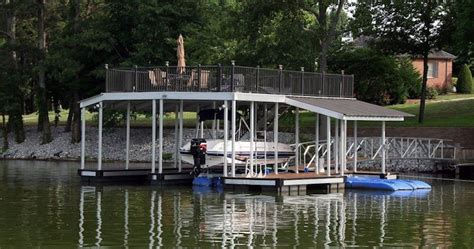
Then there’s the lake itself. Seasonal drawdown can change the appearance of the shoreline and the relationship between the house, dock and water.
So when I’m evaluating a Lake Blue Ridge property, I’m thinking about two seasonal changes at once: what happens to the view when the leaves come down, and what happens to the waterfront as the lake level changes.
Can You Improve a Seasonal Mountain View?
Sometimes.
Selective trimming may improve a view dramatically without turning a wooded mountain property into a clear-cut hillside, but this is one of those situations where I would want answers before making assumptions.
You’d want to know where the property lines are, who owns the trees, whether there are community restrictions, whether vegetation serves an erosion-control purpose, and whether opening the view could affect privacy. There can also be a big difference between maintaining an existing view corridor and trying to create an entirely new one.
The point isn’t that vegetation can’t be changed. It’s that I wouldn’t put a value on a hypothetical future view until I had a pretty good idea that creating that view was actually realistic.
Would I Buy a Home With a Seasonal Mountain View?
Absolutely. I wouldn’t hesitate simply because a listing says “seasonal view", but I’d want to understand it.
How good is the winter view?
How much disappears during summer?
Does the property still feel special when the leaves are on the trees?
Are we paying a premium that makes sense for the type of view we actually have?
Are the trees affecting the view located on our property?
And perhaps most importantly, do you like the house and property even when the mountains aren’t fully visible?
If the answer to those questions makes sense, a seasonal mountain view can be one of the things that makes a Blue Ridge home special rather than something that detracts from it. You just need to know what the words in the listing actually mean.
Because when I’m helping someone buy Blue Ridge real estate, I’m not trying to sell them the photograph. I’m trying to help them understand the property.
Ready to make your move? If you’re considering buying or selling in Blue Ridge, Lake Blue Ridge or the surrounding mountains and you’re looking for relentless representation, reach out, I’d love the opportunity to help.


Comments